|
|
Our Technology
- Dynamic networking planning and deployment model
- Supporting guaranteed real-time services with unlimited scalability
- Better network resource utilization
- Robust to wireless interferences
- Compatibility with current industrial standards
- Supporting scalable radio complexity (low power)
- Better economics and business case (low cost)
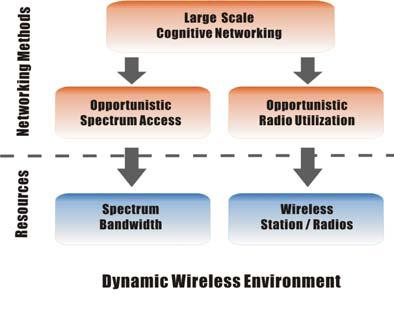
Our unique large-scale cognitive networking technology is largely differentiated from traditional wireless
networking, by its opportunistic network resource utilization of both
spectrum bandwidth and mesh station/radio availability. On the
contrary, traditional wireless networking assumes that those resources
can be predetermined.
In
principle, the cognitive-networking technology creates a dynamic (fluid)
wireless network without predetermined topology and spectrum allocation. For
example, in multi-hop wireless communications, every packet takes opportunistically
available paths in the wireless network, and with opportunistically available
spectrum on each hop. The network-resource utilization can thereby reach its
instantaneous maximum, disregarding volatile changes and the demand placed on
the network.
In
large-scale wireless networks, the problem of volatile spectrum
availability is typical in unlicensed bands where interference
prevails. Similarly, the problem of random radio availability is also
often encountered due to the dynamic traffic load and other factors
such as radio failure. In dynamic wireless environment, traditional
wireless networking seldom functions properly, given its assumption of
predetermined “virtual-wired” links and network topology for (ad-hoc)
network routing protocols. As a result, despite research and
development efforts, almost every today’s real-world wireless network
is based on single-hop wireless (e.g., cellular networks, WLAN –
wireless local area networks) rather than a true multi-hop mesh.
Our company currently holds eight patents (with a growing portfolio), comprehensively covering this innovative
technology of cognitive wireless networking. The technology can also
provide an effective application development platform for any
large-scale wireless systems.
A set of key comparative advantages of the technology is further explained as follows.
Dynamic networking planning and deployment model:
No
deterministic network topology has to be maintained, because the mesh
radio resource is opportunistically utilized. The mesh stations/radios,
when implemented with the cognitive-networking technology, become
“drop-and-play” in the network deployment. Inserting more
radios/stations can improve the radio resource to be opportunistically
exploited, and therefore increase the network capacity. Likewise
removing any individual radio/station does not create bottlenecks in
the network. This fluid “drop-and-play” nature offers the potential of
vast cost-saving in mesh infrastructure planning and deployments. The
setup of mesh stations/radios does not need expensive planning and
calibration, as multi-tier new deployments (for example introduced by
service providers or subscribers) guarantee improved network capacity.
High mobility of the mesh stations/radios can be supported.
Better network resource utilization:
The
network resource in large-scale wireless networks includes: the amount
of spectrum bandwidth and the number of mesh radios. Theoretical
network capacity is decided by the network resources, and the
multiplication of these two factors. Traditional wireless networking
depends on a deterministic mesh-network topology. It is therefore
difficult to efficiently utilize the network resources, subject to a
dynamic wireless networking environment where both spectrum bandwidth
and mesh radio availability cannot be predetermined. Our technology
offers a means of better network-resource utilization, approaching the
information-theoretical limit on wireless-network capacity.
Supporting guaranteed real-time services with unlimited scalability:
Due
to the opportunistic network-resource utilization, reliable wireless
communications with specified dataflow throughput, end-to-end delay,
and delay variance can be supported over multiple wireless hops.
Therefore, real-time services, including high-quality multimedia (over
Internet Protocols), can be supported in a wireless mesh infrastructure
by the cognitive-networking technology. In order to better understand
this, note that the opportunistic exploitation of local
random-networking environment can result in overall reliable end-to-end
communications. Dataflow throughput is independent of the number of
wireless hops; end-to-end delay and delay variance only increase
linearly with the number of wireless hops; and delay variance can also
diminish to zero with higher network density. Therefore, network
operators only need to assure that sufficient network resources are
deployed to support their applications, so as to provide guaranteed
services of real-time communications, where the resources, e.g.,
gateway capacity and mesh radios, can be deployed with low cost.
Robust to wireless interferences:
Due
to the opportunistic network-resource utilization of spectrum
bandwidth, the network is very robust to interferences which can be
substantial in unlicensed spectrum bands (e.g., ISM bands). For
example, viable operation within unlicensed bands brings large free
bandwidth to wireless mesh infrastructures, which results in large
network capacity with virtually zero cost.
Compatibility with current industrial standards:
The
cognitive-networking technology can be compatible with all established
wireless radio standards, so that the implementation can be independent
of physical radios. Therefore, the radio modules (with
cognitive-networking capabilities) can use off-the-shelf RF chips which
offer relatively low cost. The implementation can also be seamlessly
integrated with all network-layer protocols, including for example
Internet Protocols.
Supporting scalable radio complexity (low power):
The
complexity of individual radio modules (with cognitive networking
capabilities) is low and independent of network scale. The low radio
complexity results in low power consumption, lower cost, and long
battery life. When needed, it also makes it possible to power the mesh
radio by cost-effective solar panel, which will further reduce
installation cost by removing any cable attachment.
Better economics and business case (low cost):
As
explained above, the cognitive-networking technology can offer
excellent economics in large-scale wireless systems, by which 1) the
costs of deploying network resources could be vastly reduced by the
utilization of unlicensed spectrum bands and drop-and-play or mobile
mesh radios; 2) much higher efficiency in network-resource utilization
results in excellent performance with all the available resources being
used to their instantaneous maximum.
|
|
|